We had been moving so fast, we hadn’t had time to really enjoy our hotel, except for a few minutes before dinner here and there. After our visit to Chateau Haut Bailly, we were pleased to spend the rest of the day today exploring at our hotel, the beautiful Les Sources de Caudalie, which had been highly recommended by many people. Located among the vineyards at Chateau Smith Haut Lafitte, it was a perfect respite from all the running around we had been doing.
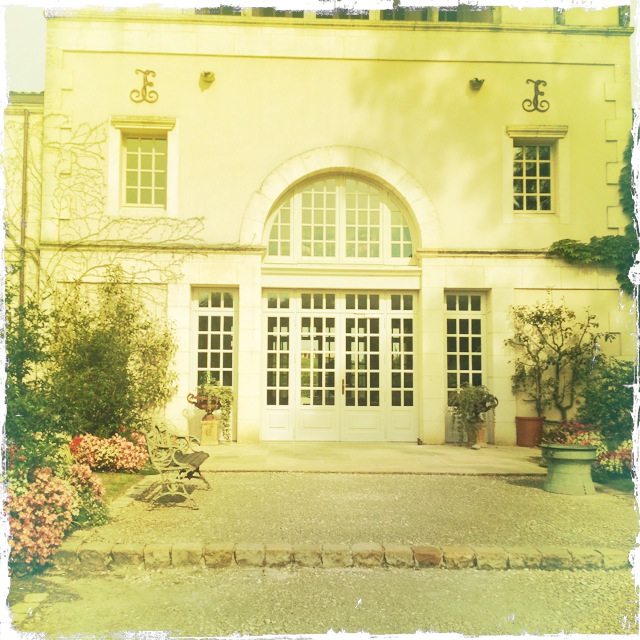
Les Sources de Caudalie.At the front entrance of Les Sources de Caudalie. (I used the vintage hipstamatic photo app on my phone, which I think adds to the romance of the place.)A view of the back entrance.
We enjoyed a light lunch on the terrace, watching the ducks in the pond, and then took a walk around the property, before enjoying a glorious massage at the namesake spa.
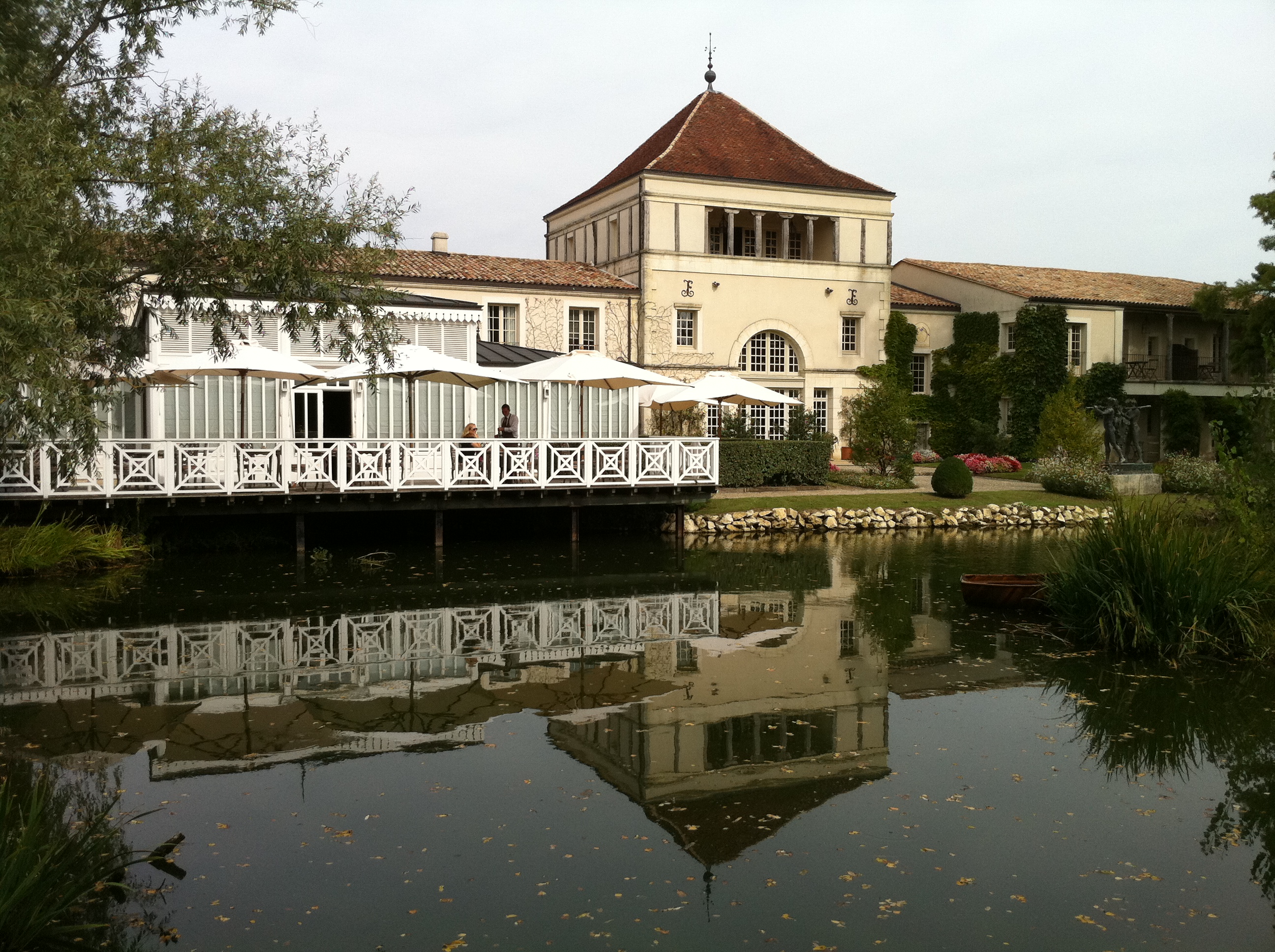
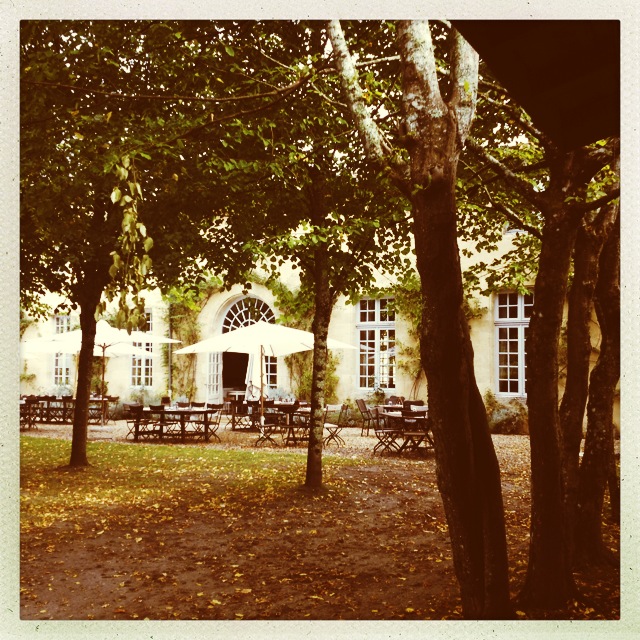
A view of the terrace where we had lunch. (Bob didn’t use the same app I did for his photos, thus, you get a little of both types of photos in our recaps.)Another view of the terrace where we enjoyed a terrific lunch.The view of the pond and another guest cottage from our terrace.So sweet. Wonder if you could take the rowboat for a ride?Ready for a conversation…A cute nook.We never had the time to play a game.But we did have time to grab a glass or two of the Blanc de Lynch Bages one night. Yum! I miss that wine…Another building on the property.
Post-rubdown, we luxuriated in the sun by the pool. Bob ran back to the room to grab some wine – and came back with a split of Krug! Of course. For once he didn’t manage to smuggle it over in his luggage – he actually managed to purchase it back when we were in Bages, and chill it in our room, all without me noticing. This is one of his favorite tricks.
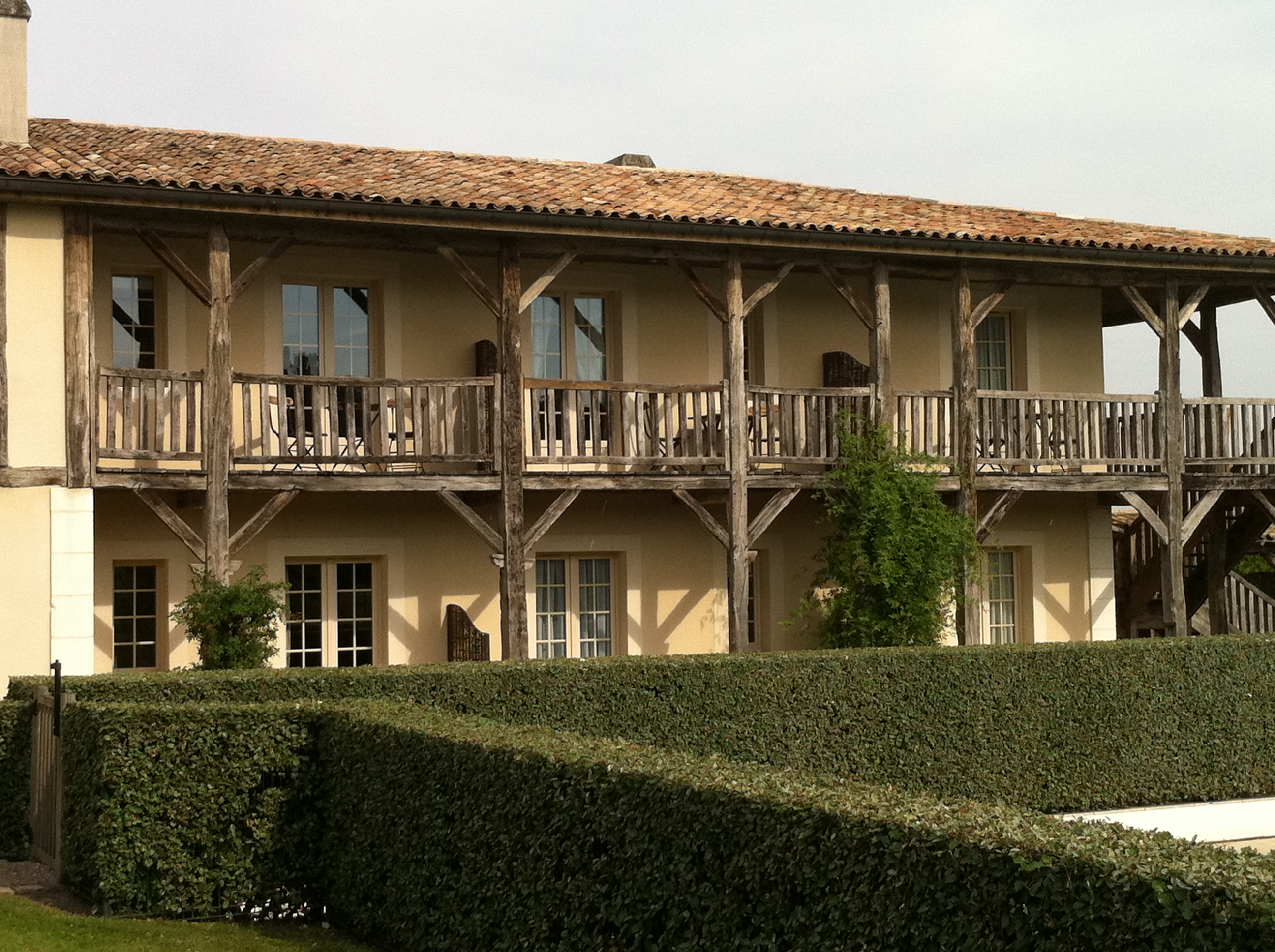
Our room was next to the pool. The building behind it is the separate spa.It just so happened that our afternoon in the sun was on the warmest day of the trip – lucky us. It was VERY warm though – unseasonably so. An interesting year for the grapes!The man and his Krug.
All said and done, I have to say, I much prefer the Krug trick to the one he played next. We realized our afternoon in the sun had to come to a close, because we had a late afternoon appointment on the property to tour the Ch. Smith Haut Lafitte winery. Upon arriving back at the room, however, we were missing Bob’s room key. Where could it be? A frantic search ensued, as we were already running a wee bit late.
Can you guess where we found it? In his spa robe pocket, retrieved by the maids after it had traveled down the laundry chute! Mystery solved, we cleaned up as best we could and ran, breathless to our next appointment…which turned out to be another fun adventure!
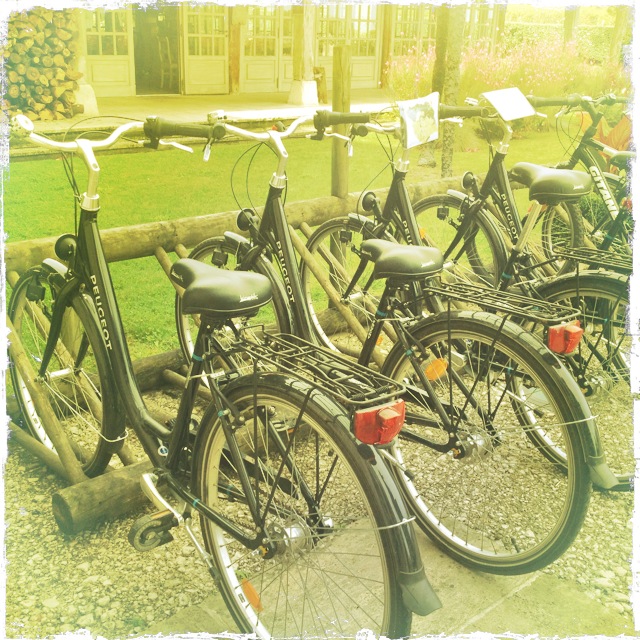
We didn’t start out on bikes, but we sure did end up on them…!
We were warmly greeted at Chateau Haut Bailly by a member of their PR team. In addition to spending time touring the estate and discussing their winemaking practices, she and Christina also spent some time talking about marketing in Bordeaux. In particular, the level of international acclaim the region gets, and how the various chateau decide where to spend their marketing efforts. It’s always an interesting conversation, but generally ends with the same conclusion – the UK is the backbone, the US is the elephant you can’t ignore and China is the darling that they hope won’t ditch them at the ball. (Our words, not hers!)
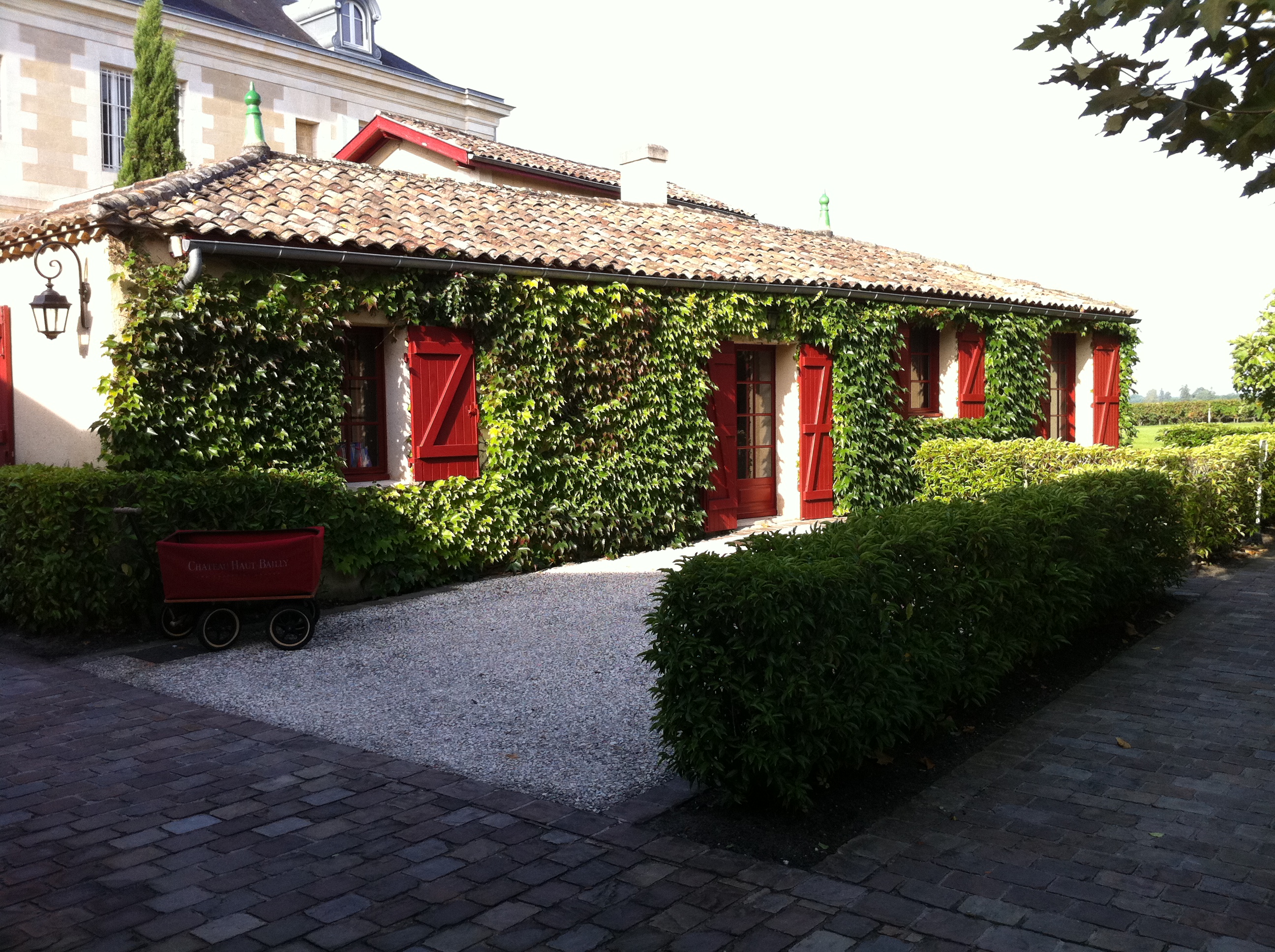
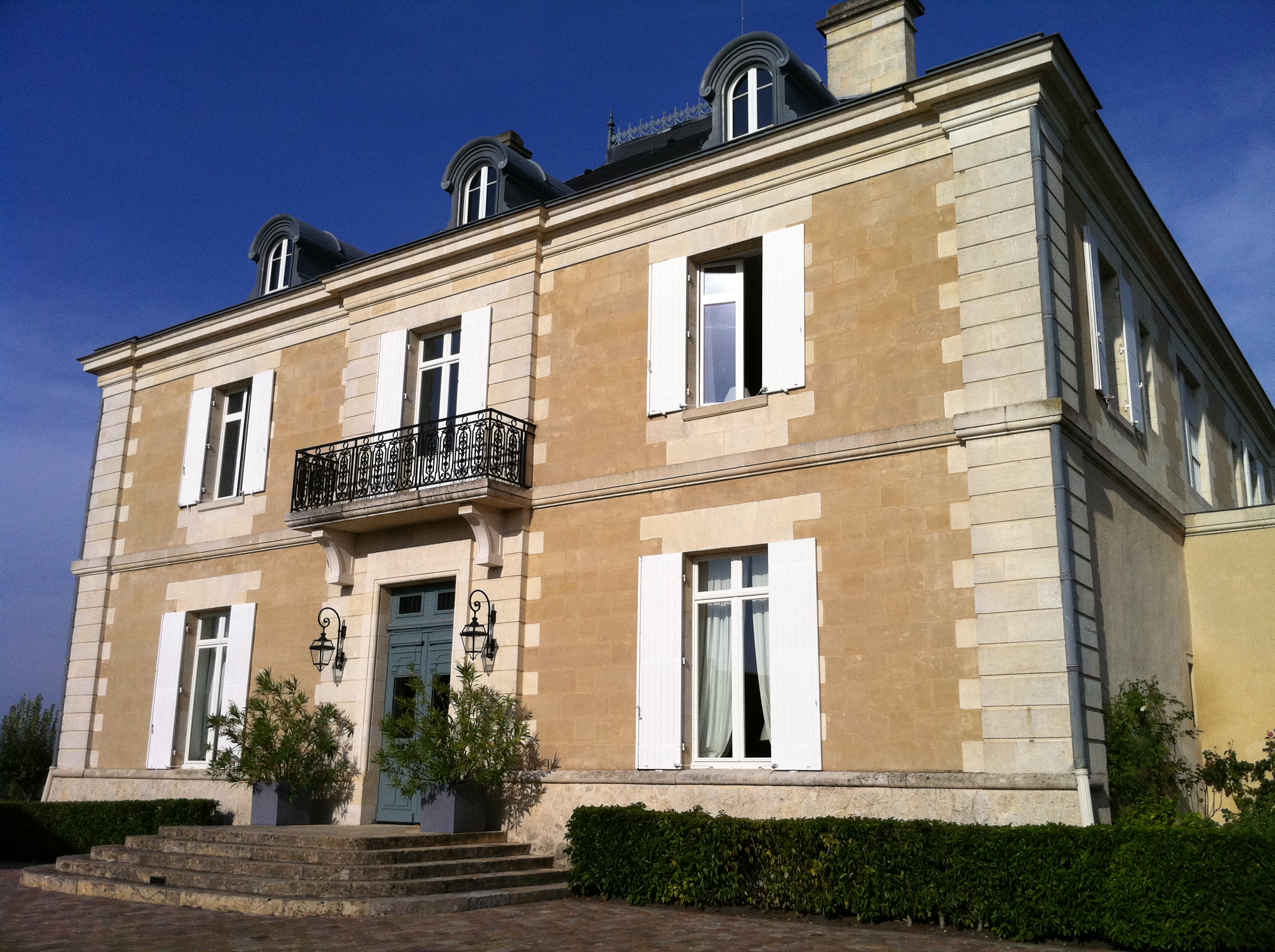
Chateau Haut Bailly.They had recently renovated some of the buildings.The front of the chateau.
The Chateau Haut Bailly estate was founded in the 14th century. The vineyards are planted on limestone and fossilized shells, which gives a unique character to the wines produced here. The vineyard is also located at one of the highest elevations in the Graves region of Bordeaux. Chateau Haut Bailly did extremely well in the 19th century, where is was given the classification of “cru exceptionnel” among the Bordeaux Grand Crus Classes. In the Graves region of Bordeaux, only Ch. Haut Brion and Ch. Haut Bailly were considered at the top.
Today, an American couple, Robert & Elisabeth Wilmers, own Ch. Haut Bailly, purchasing it back in 1998. Robert Wilmers is currently the CEO of M&T Bank, and his passion for the estate is evident in all of the work he has invested in raising the quality of Haut Bailly’s wines to their former glory. They have 26 thermal-regulated traditional cement vats for the fermentation process, ranging in sizes from 30 to 120 hectolitres. The 26 cement vats enable them to ferment the different lots separately. They definitely had one of the more impressive cement vat installations that we saw on our trip. They also use modern stainless steel vats for the blending process.
The traditional cement vats.The newer stainless steel vat room.
Here’s what we tasted:
From half bottle to an 18 liter Melchior (two cases of wine in one bottle). No, we didn’t taste all of that!
2008 La Parde de Haut Bailly – Very bright floral red cherries, high acid and good mouth-feel. Medium bodied with a nice structure of fine tannins. Sweet, spicy red fruit on the medium length finish. This is a nice 2nd wine.
2008 Haut Bailly – Deep dark ripe spicy blackberry fruit nose. Smells like a blackberry pie. In the mouth, very dark delicate black fruit, with very good acidity keeping it lively. Nice structure of very fine tannins on the long dark spicy black fruit finish. This is an excellent 2008 Bordeaux wine, beautifully made. This will also be a great value in comparison to the competition.
We left Ch. Haut Bailly to head back to our hotel nearby for lunch. It was turning out to be a gloriously warm and beautiful September day…perfect for lounging by the pool!
There was something almost magical about our final destination for the day, Chateau Guiraud. Maybe it was the time of day (mid-afternoon), and the way the sunlight played off the facade of the stone building, but it seemed a very warm and welcoming place, not quite as imposing as some other Chateau in the region.
The charming Chateau Guiraud.
We actually found this to be a good metaphor for the entire visit at Guiraud. Our lovely guide started by telling us stories about the history of the Chateau. It began as the “Noble House of Bayle,” when it belonged to the Mons Saint-Poly family. In 1766, Pierre Guiraud, a Bordeaux merchant of Protestant faith purchased the estate. The Guiraud label is one of the only black labels on a Sauternes bottle from the region, and this was apparently somewhat deliberate, as the new owners were considered the black sheep of the area. They were not local, not Catholic, and their political views also greatly differed from the prevailing local sentiment. On his death in 1799, Pierre’s son Louis, succeeded him. It was under Louis Guiraud that the estate was saved from a severe devaluation which had begun in 1793, becoming a famous château well-known for its wine. On Pierre’s death in 1837, his son Pierre-Aman inherited a well-established property. Within 80 years and three generations, various families succeeded each other as owners of the estate. The legend was born in 1855 when Château Guiraud became a Premier Grand Cru de Sauternes.
The estate.
Also according to the Guiraud website, during a dinner in early 2006, Robert Peugeot, an industrialist, and three wine makers, Olivier Bernard of Domaine de Chevalier, Stephan Von Neipperg of Château Canon La Gaffelière and Xavier Planty, the estate’s director, decided to buy Guiraud. They signed a purchase contract on July 20, 2006, thereby uniting their shared passion for wine, gastronomy, nature and hunting.
Chateau Guiraud had just begun their harvest.
Chateau Guiraud had begun harvest the day we arrived, so we were lucky enough to meet the estate’s director, Xavier Planty. We were also lucky to taste some very nice vintages from Guiraud:
2010 Petit Guiraud – Very bright light fruits with a good dose of spice and very good acidity, lively in the mouth. Medium bodied and long spicy fruit finish. This is an excellent 2nd wine.
2003 Chateau Guiraud – Ripe peaches, apricots and spicy orange marmalade, very good acidity for the vintage. Very long finish of peaches, a little orange rind and spicy honey. This is an excellent 2003 Sauternes.
It was fun to watch Christina taste these wines. She had a very positive reaction to the 2003 Chateau Guiraud, and I will say I found it to be a more complete wine than the rest of what we tasted that day as well. In general, I have not liked the Sauternes from the 2003 vintage. I have found them lacking in acidity and a little too cloyingly sweet for my taste. What I discovered, is that Chateau Guiraud uses the 30% – 35% Sauvignon Blanc in their blends, where most Chateaux only use 0% – 15%. This extra percentage of Sauvignon Blanc give the wines of Chateau Guiraud more acidity than the other Chateaux in Sauternes. Knowing that I prefer Sauternes with higher acid, it makes me very happy that I have a fair amount of wine from Chateau Guiraud resting in the cellar. The 2001 Chateau Guiraud is an excellent Sauternes and a very good value for the quality.
The tasting room.
Ah, what a day. Now we were headed back to the hotel. We spent most of the next day lounging about at Les Sources de Caudalie – and having a few fun new adventures – can you say underground cellar? Stay tuned…
The stunning trees lining the drive at Chateau Guiraud. Hard to leave such a pretty place…
My wife first fell in love with Chateau d’Yquem at the Poncho Wine Auction in Seattle at least a decade ago. The auction had set it up so that every time someone won the bidding on a live auction item, you would also get a glass of 1983 Chateau d’Yquem from a six liter bottle. Some friends of ours at the auction “won” a lot of auction items, so they had a lot of Yquem flowing their direction. We were pleased to be the lucky recipients of their “spare” glasses. It was at this moment that Christina had her first wine epiphany about Sauternes and Chateau d’Yquem in particular.
You see, this was Christina’s first time tasting any Sauternes, much less Yquem. After tasting the ’83 Yquem and not knowing how expensive it is, she told me that THIS was her favorite new wine. I smiled and said, “Great, now your wine habit is more expensive than mine.” We had a good laugh and I remember that moment every time we drink Chateau d’Yquem, which of course, is never often enough.
Christina Watt at Chateau d’Yquem. Pilgramage complete.
The Chateau d’Yquem estate is quite impressive – here’s some quick history. Back in the middle ages, Chateau d’Yquem was owned by the King of England, who was also the Duke of Aquitaine at the time. In 1453, the southwest of France was again brought under control of the French crown by Charles VII. In 1593 a local noble family of Jacques Sauvage was given the feudal rights over d’Yquem. History showed that special winegrowing practices and late harvesting already existed at this time. A few years later, the Sauvage family built the present Chateau and purchased more land around it make the current d’Yquem property known today. In 1711, under the reign of Louis XIV, Leon de Sauvage d’Yquem, which had nobility status, was granted full ownership of Chateau d’Yquem. In 1785, Leon de Sauvage d’Yquem’s great-granddaughter, Francoise Josephine married Count Louis Amedee de Lur Saluces.
Three years later the Count was killed in a horse riding accident and Francoise Josephine took over the management of the property. The family maintained ownership of the d’Yquem property, until 1996, when the famous luxury goods company LVMH, purchased half of the property. Unfortunately, the relationship between the family and LVMH was not a good one. After multiple lawsuits, LVMH purchased the remaining half of Chateau d’Yquem in 2004. LVMH then arranged for Pierre Lurton, who was already managing their other property, Cheval Blanc in St. Emilion to take over management of Chateau d’Yquem.
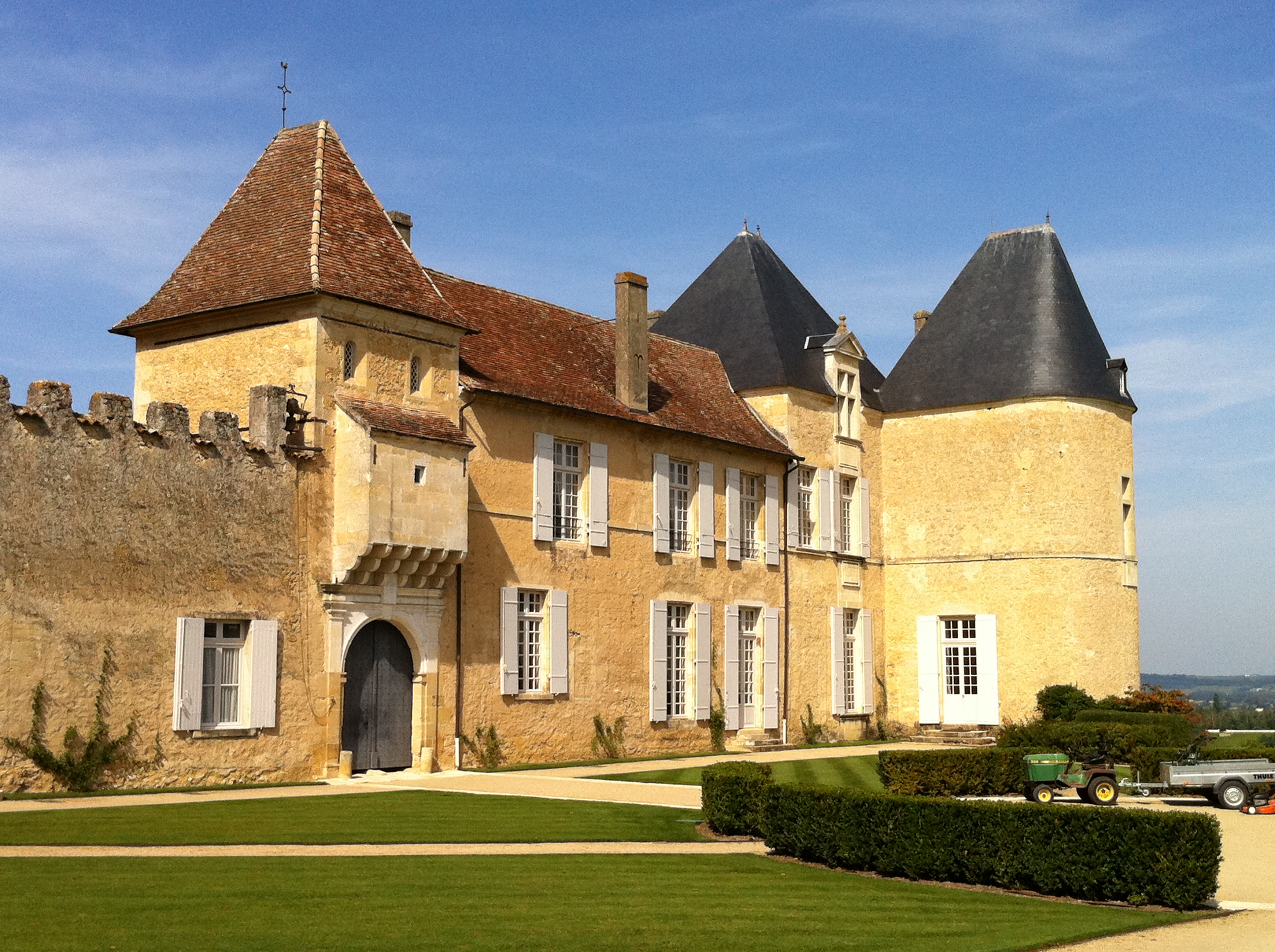
Another view. The Chateau has a very Medieval feel to it.The turrets.
Chateau d’Yquem is located on top of a hill and is the highest point of elevation within the Sauternes region, which gives it a unique micro climate. The vineyards of Yquem are planted with 80% Semillon and 20% Sauvignon Blanc. We joined a group meeting under the shade of a tree on a small hill overlooking the vineyards to begin our tour. It was a hot day, and we were all grateful for that bit of shade!
Overlooking the vineyards of Chateau d’Yquem.The cellars – dark, but an impressive sight.
It was fascinating to learn that the same people generally harvest the grapes for Yquem year over year. While this is not necessarily unusual for wine estates, what was unusual was that the same people generally pick the same few rows each year, so that they get to know their vines very intimately. Given that they pick multiple times in a season – up to 13 times to harvest the individual grapes at their optimal ripeness – you can see how having the same people picking would be a great advantage. You can also see how heartbreaking it would be for those workers when a year turns out to be disappointing with the weather, especially because Yquem is one of the few Chateau that will simply not declare and release wine in what they feel is a truly bad vintage. The years that Yquem has not declared a vintage are: 1910, 1915, 1930, 1951, 1952, 1964, 1972, 1974, 1992 and 2012. They say it happens about once a decade, and it is a true testament to the level of quality they expect from their esteemed estate. (It also explains the pricing and comparison to liquid gold.)
Heading out of the cellar to the tasting. Interesting architecture.
To that end, it was pretty funny to watch the group tasting the Yquem after the tour. The tour guide mistakenly left an open bottle on the counter with about a quarter of a bottle left. One of the gentlemen quickly spirited it away and gave himself a VERY healthy second pour, even tilting the bottle to his mouth and licking the last drops off the lip of the bottle. I admit, we grimaced, but he seemed perfectly okay with his decision. The guide caught the faux pas a little late, but quickly grabbed the other open bottle and very firmly replaced the cork before others had the same idea.
Part of our group hanging out in the tasting room.
It is widely known that there is Sauternes, “and then there is Yquem.” If it is a good year or just an okay year, there is a noticeable difference between Ch. d’Yquem and everyone else in Sauternes, but it is more noticeable in the off years. I have not found this to be the case in the other regions of Bordeaux or anywhere else in the winemaking world. I do have to say though, that starting with the 2001 vintage, there are some unbelievably well made Sauternes out there now. The competition is catching up to Yquem, but Ch. d’Yquem truly is still the King of Sauternes.
We tried the 2007 vintage that day, which was drinking pretty well, though it wasn’t knock-your-socks off good – even Christina with her deep affinity for Yquem quickly realized it was missing a little of the sparkle present in most of their wines. Here’s my review:
2007 Chateau d’Yquem – Bright pineapple, spicy honey, dried apricot, good acidity, slightly cloyingly sweet. Very good length in the mouth, sweet and spicy on a very long finish. This is an excellent Sauternes, but only okay for d’Yquem.
It’s been a while since we posted a daily drinker, but we’re off to the Seattle Opera this evening to see Rigoletto, and going to the Opera reminds me of a new wine we recently discovered that has turned out to be a great daily drinker.
Usually, we start off the evening at one of our favorite restaurants, Toulouse Petit, with a few quick bites and a glass or two of wine. Their foie gras is some of the best in town, as is their duck confit – and oh, just about everything else on their amazing menu. (If you’re in Seattle and you want to check them out, make a reservation – they can be impossible to get into!)
Over time, we’ve gotten to know Joe, the restaurant manager and wine buyer. We’ve complimented him in the past on his great, affordable wine selections, and in particular, there’s been one wine that we thought was a great little gem for the money. I actually managed to track it down, and we’ve been enjoying it on non-Opera nights now too. It’s a Tempranillo, which is one of Christina’s new favorites for the spicy, yet full-bodied flavor. She refers to it as great “pizza wine,” though it’s good enough to open for friends, for sure – we highly recommend it. And at roughly $13 a bottle, you can open plenty of them!
2009 Lo Nuevo, Tanto Monta – Old Vine Tempranillo – Spicy black fruit nose. In the mouth crushed black berries and black currants, with some spice and a little bit of earthiness (in a good way). Medium-full bodied with very good acidity and a nice long sweet black fruit finish. Tasting this blind, you would never guess you were drinking a $13 bottle of wine.
Looks like we’ll have to open a bottle tonight at home before we go. We’re especially looking forward to this Opera – we met a few members of the cast at a Christmas party in December. They had just arrived in town from New York and Florida the day before the party, and were getting settled in. The show is getting great reviews – I’m sure they’ll be spectacular.
Christina Watt with Donovan Singletary (a Bass-Barintone playing Monterone), and Nadine Sierra (singing Gilda, the lead Soprano role) in Rigoletto at the Seattle Opera.
As we drove along in the “mystery beast” throughout Bordeaux (more on that in a minute), Bob couldn’t help but notice a couple of spectacular cars that we had to stop and admire. His dad used to race cars like these when he was growing up, so he can never resist taking a good look. I suspect you’ll admire them too.
In the village of Bages:
A mint condition Triumph roadster.Another view.
In the town of St. Emillion:
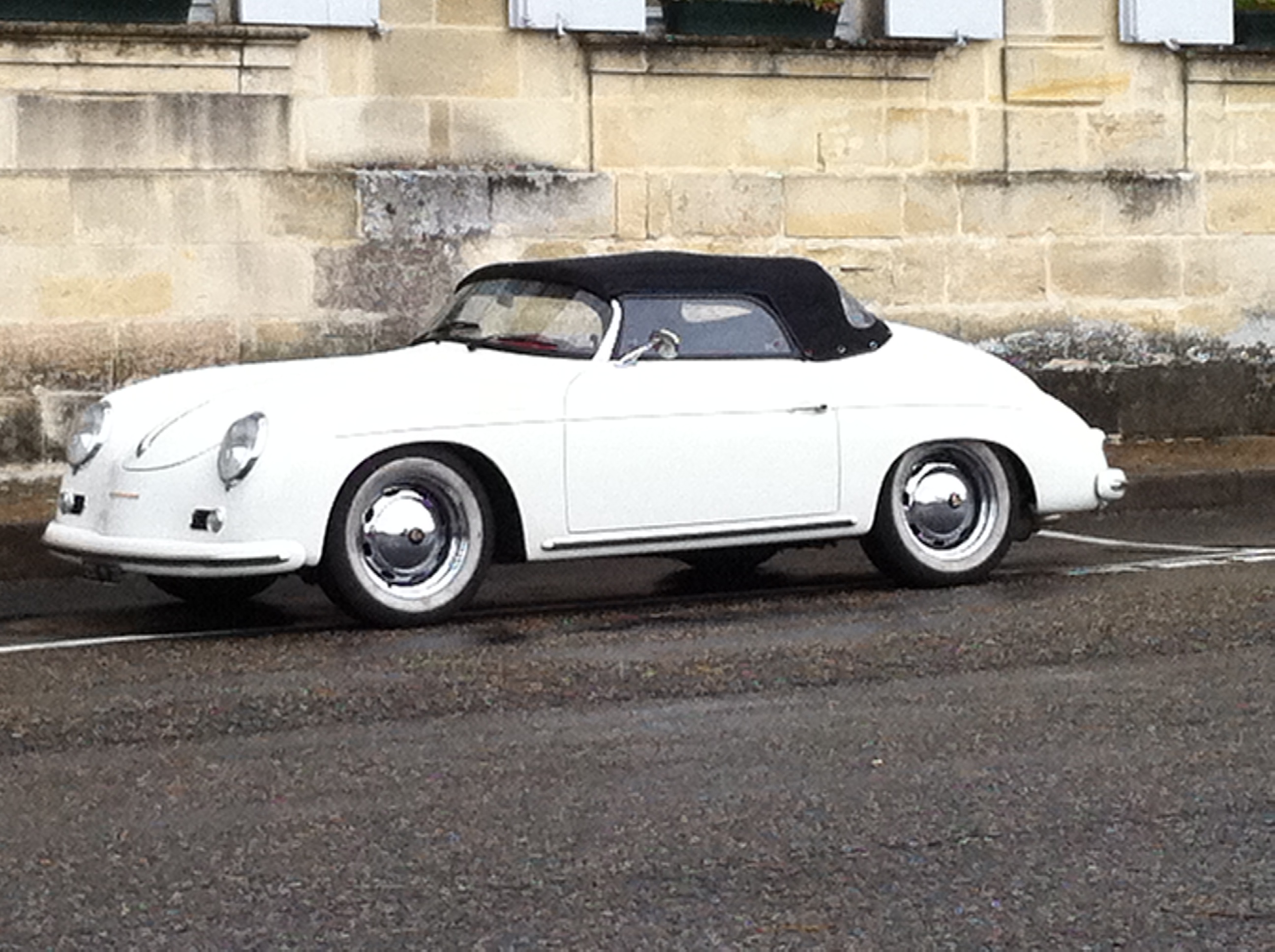
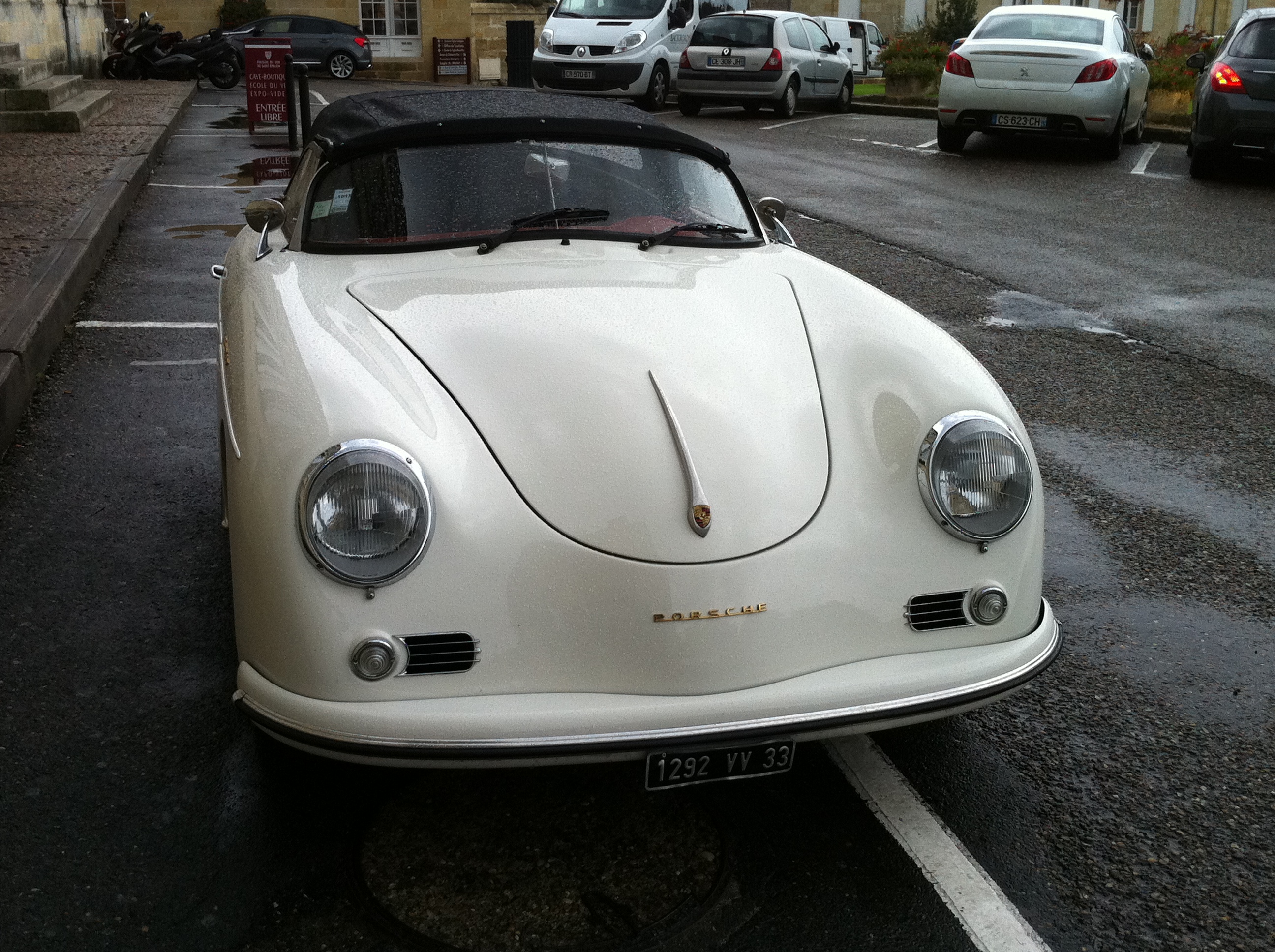
A beautiful vintage Porsche.A closer look.Just gorgeous.
At Les Sources de Caudalie:
A nice Maybach. Wish the photo showed you the interior – believe me, it wouldn’t suck to tour in this ride.
Even these guys made us smile in Sauternes:
A fun little fleet at Chateau Suduiraut.
But what didn’t make us smile? Our rental car. We had reserved a Mercedes, since we figured we’d be spending a lot of time in the car (and an automatic, so I could also drive it if need be), but missed the fine, fine print (Mercedes “or like model”). When we arrived, of course, there was no Mercedes to be found at Europecar, and more disturbingly, no automatics either. (Yup, I’m mentioning them by name.) Instead, we got the closest possible thing they could find for us. A manual BMW, which in theory, would have been just fine. IF it hadn’t been missing the emblems on both the front AND the back of the car, and had been an automatic.
The mystery beast.
Yup, you have to be pretty cool to drive the mystery beast – they don’t let just anyone behind the wheel of this baby…!
The town of Sauternes is a charming little town right in the middle of the vineyards of Sauternes. Before lunch, we walked through the town, looking at the various buildings and shops.
Christina Watt in the town of Sauternes.Bob Watt in Sauternes.Sleepy and quaint.
We came across a cute wine shop that was doing a tasting of Chateau Lamothe Sauternes.
The super cute wine shop.
Miriam, the delightful woman running the store, happily shared these wines with us:
Miriam was very gracious.
2009 Chateau Lamothe – Nice bright nose of peaches and pears. In the mouth, very fresh peaches, pears and some spice, with good acids and a complex long finish. The finish of this wine stays in the mouth long after it is gone. A very nice wine and one to look for.
2005 Chateau Lamothe – Bright nose of white peaches with a little spiciness. In the mouth, white peach, hint of pineapple and a slight spicy honey note. Very good acid on the slightly spicy white fruit medium long finish.
2001 Chateau Lamothe – Subtle but very complex nose of peaches, pears, green melon and spicy honey. In the mouth, very delicate flavors of white peaches, pears, spicy young pineapple and a hint of honey. Keeps changing in the mouth. Very good acid and a very long complex finish that won’t quit. This is a very nice wine and one to look for if you can find it.
2000 Chateau Lamothe – A more mature nose of yellow peaches and some ripe pineapple. In the mouth, ripe peaches and pineapple combined with a little mango. Decent acid and a nice long finish of ripe fruit. The 2000 doesn’t have the energy of the other three vintages, but it is drinking well now.
After the tasting, we wandered across the street to Les Sapien. Honestly, if we had realized how good this lunch would be, we would have made way more time for it. We were on time for our reservation, but it was scheduled tightly, with a visit to the fabled Chateau d’Yquem looming large. What a shame it was, because this lunch was easily one of the best meals we had on our trip.
A partial patio view of the restaurant, Les Sapien.
After the starters, Christina got a pork tenderloin dish that was truly amazing, while I opted for the fish, which was also very well-prepared. If you know me, you know I’m not a dessert person – while I can tolerate the sugars in wine, I don’t typically do well with the sugar in most desserts. This dessert, however, was a rare exception. Blue cheese ice cream. I’m not sure how to describe it, except to say I can still remember how good it was – and how I had to fend off the occasional wandering spoon from Christina. We had a very nice dry white wine with our lunch, produced by Chateau Suduiraut called Suduiraut Blanc Sec.
2011 Chateau Suduiraut Blanc Sec – Very bright and crisp, with strong lemony acidity, almost like a Chablis (which I love). Very nice white fruit and green melon with just a hint of spice from oak. Nice medium-long clean and refreshing finish. I have never seen this wine in the states, but I will look to see if I can find it. It is a great summertime sipper, especially while overlooking the vineyards.
I think this is the only picture we got of the food. We were in such a hurry, that it wasn’t until we were about halfway through that we realized we should have really been recording more of the meal!
We had to depart the restaurant all too soon, but we vowed to return again one day – for a leisurely dinner on their spectacular patio. If you are ever in the area, this is a must-stop restaurant. Next up – the legendary Chateau d’Yquem!
Today we visited the region of Sauternes – I think Christina was looking forward to this day of our trip more than any other. My wife used to like to share an occasional glass of port with me, until she discovered Sauternes. While Christina still does like a nice port, she absolutely loves Sauternes, hence we don’t have as much port as we used to!
Sauternes at last!
Our first stop was at the venerable Chateau Suduiraut. The estate was named Chateau Suduiraut in 1580 with the marriage of Nicole d’Allard to Leonard de Suduiraut. The Chateau was looted and burned down in the Fronde insurrection of the 1640’s and then rebuilt in the late 17th century. Chateau Suduiraut was classified as a Premier Cru in the 1855 classification. Chateau Suduiraut was purchased in 1992 by the AXA Millesimes global investment and insurance company group. AXA Millesimes is headed up by Christian Seely and the company also owns other properties, such as Chateau Pichon Baron in Pauillac.
Christina Watt at the beautiful Chateau Suduiraut.The grounds were very pretty – there was a lunch being set for a special event.An interior courtyard.
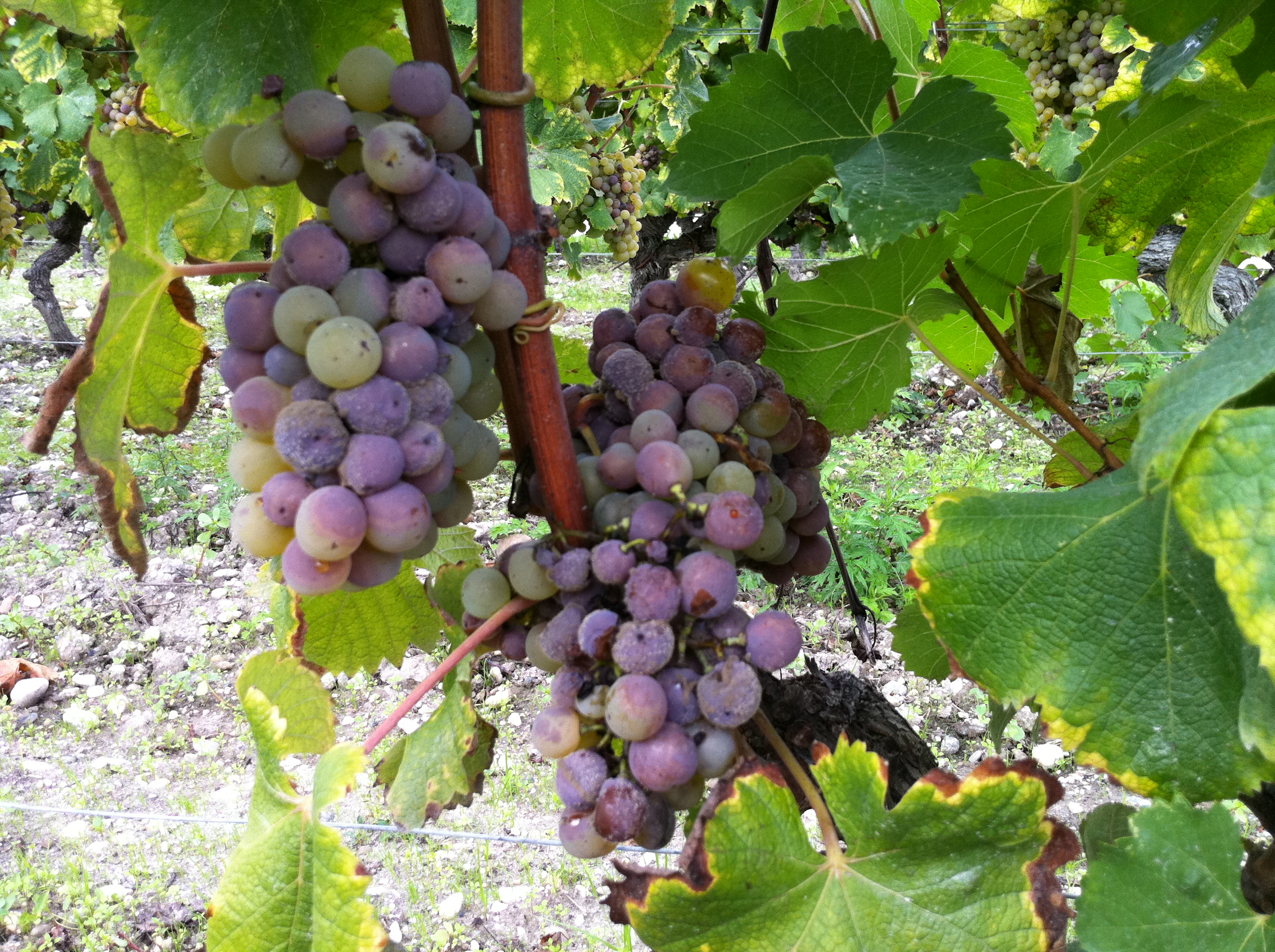
The wines of Sauternes and Barsac (just to the north) are made from Semillon and Sauvignon Blanc, but there are a few Chateau that add a little Muscadelle to some of their wines. Chateau Suduiraut is a blend of 90% Semillon and 10% Sauvignon Blanc. The wines can age for decades and even a 100 years in the great vintages. What makes the wines of Sauternes and Barsac so special is what they call “noble rot”. Noble rot is a fungus called Botrytis Cinerea, which is present on the undeveloped fruit after flowering. If the season is damp, then the Botrytis fungus develops into grey rot, which makes the grapes unusable. If there are damp mornings followed by hot days, the Botrytis fungus develops into noble rot. The noble rot shrivels the grapes, by reducing the amount of water in them and concentrating the flesh and sugars. It is this noble rot that gives the wines of Sauternes and Barsac their great sweetness balanced by wonderful acidity.
Chateau Suduiraut is a beautiful estate of 92 hectares in the middle of the Sauternes region. Our knowledgable guide, Camille, showed us around the estate. Chateau Suduiraut uses traditional wine making practices and stainless steel vats for their wines, which are aged for 18-24 months in French oak barrels. The estate will pick through the vineyard up to 5 times during harvest, to keep pace with the development of Botrytis and ensure the optimal quality of the grapes. It is this painstaking attention to detail that makes the wines of Chateau Suduiraut so wonderful – and what makes a good sauternes a very special treat.
The progress of the grapes. From here…To here…To here, getting ready for harvest with the appearance of noble rot.You can easily see why they have to pick in cycles, waiting for the grapes to mature.
The wines that we tasted at the estate were:
2006 Castelnau de Suduiraut – This is the second label for Chateau Suduiraut. Sweet and spicy nose of pineapple and white fruit. In the mouth, spicy pineapple combine with sweet white peaches and good acidity. Finishes with a nice long balanced sweet fruit finish.
2006 Chateau Suduiraut – Complex subtle nose of white fruits and a hint of pineapple. Very creamy and smooth in the mouth, very delicate. This wine feels lighter in weight in the mouth than the 2nd label does, but is much more complex and very fresh tasting. The sweet white peaches and pears combine with young pineapple flavors. The wine has very good acidity and there is a noticeable spiciness from the botrytis on the very long sweet white fruit filled finish. This is an excellent Suduiraut, and one to look for.
1989 Chateau Suduiraut – Wonderful nose of peaches, ripe pineapple and orange peel. Smooth in the mouth with yellow peaches, pineapple, spicy honey and good acidity. Nice long complex spicy fruit filled finish.
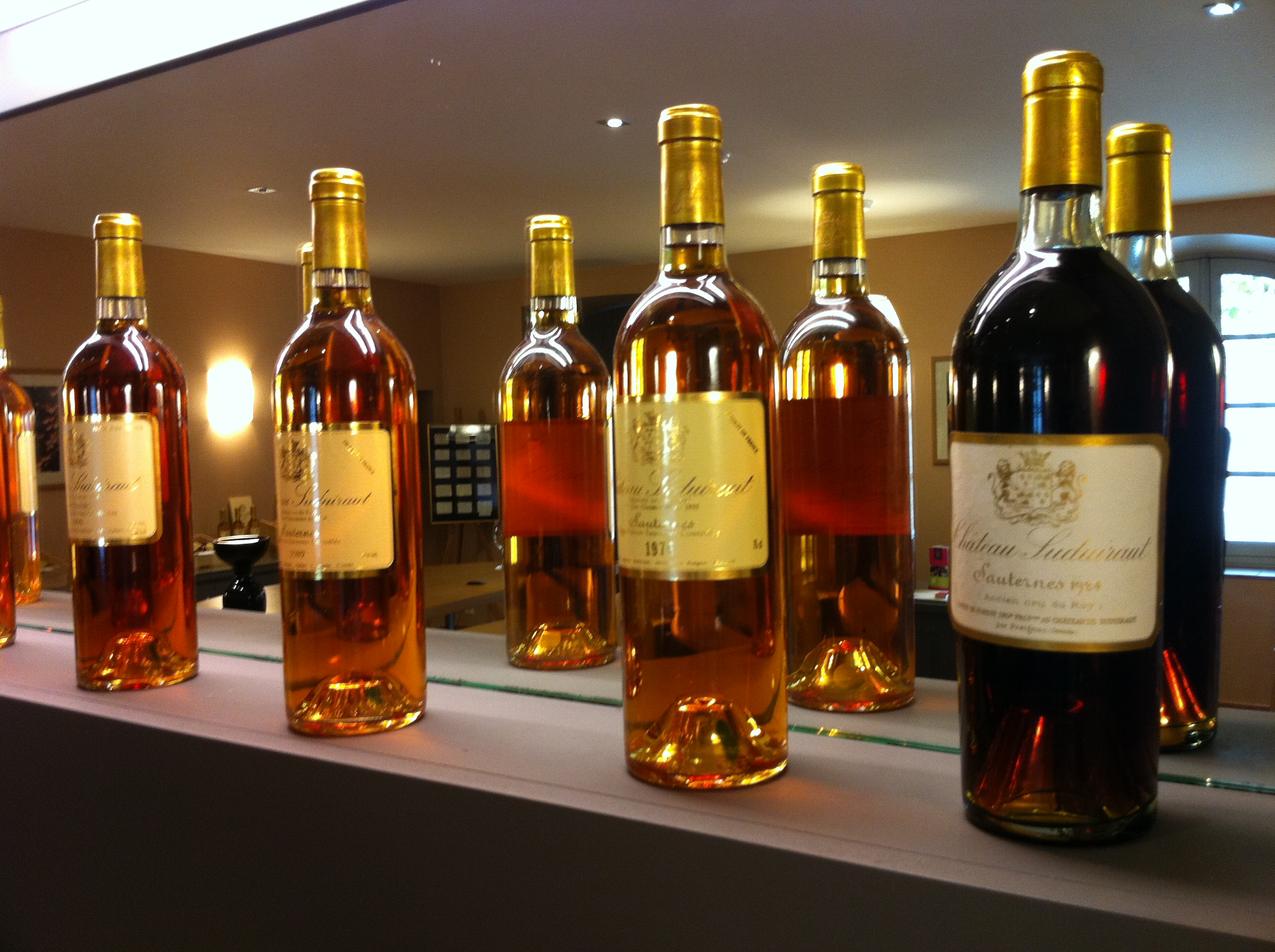
A spectacular display of Sauternes.A few fun vintages.
Chateau Suduiraut makes some of the very best wines in Sauternes. If you are a fan of the wines from the Sauternes and Barsac region or just dessert wines in general, I would highly encourage you to try the wines of Chateau Suduiraut. These wines are wonderful drunk young after realease, but will develop so much more complexity with age if you can keep your hands off of them. (The only way I can keep my wife’s hands off of them is to bury them in the cellar!) I am very happy to have quite a bit of Suduiraut in the cellar – when she figures it out, Christina will be too.
From our at home tasting experience, I can also tell you that the 2001 Suduiraut is absolutely off the charts and will be one of the very best dessert wines that most people have ever had, definitely a wine to hunt for. 2009 is also stellar vintage for Sauternes and Barsac. If you like dessert wines, this is a vintage to buy by the case. The 2009’s have sweet fruit, great acidity and they will age a very long time (many decades), but the 2001 Suduiraut will age gracefully longer than anyone who is able to read this blog. It really is that good…
Speaking of good, we ventured next into the little town of Sauternes, which was truly, just great!
Wouldn’t it be fun to drive off in one of these cars from the estate??
By now you may be wondering – just how long is this Bordeaux tour?? It was 12 days, so we’re more than halfway done recapping our visits (thank goodness, right?) – and we have the fabulous town of Sauternes coming up next.
So far, all had gone remarkably well on our tour. But we were confronted with an unusual circumstance this evening – we didn’t have dinner scheduled anywhere.
After eating so much heavy food (I’m normally gluten and dairy-free), I really was craving something light. We were heading in the direction of Bordeaux city as we went back to our hotel that evening, so we asked Nicolas Glumineau of Pichon Lalande at lunch that day for a dinner recommendation. I threw out sushi, and he threw me a look – apparently that was asking for a lot in Bordeaux.
Then he remembered a Japanese restaurant in town very near where we had stayed the previous weekend. He couldn’t remember the name, but he sketched out a little map on the back of his business card, and we thought it looked simple enough.
We made our way back to Bordeaux easily enough and found parking without fuss. As we drove through town, I saw a small restaurant on the corner very near where we had originally stayed, advertising sushi. We decided it could be the back-up plan.
We followed the little map as best we could, but the best thing we could find was the store Badie – no sushi, but a store of all champagne – Bob thought he’d died and gone to heaven. The concept appeared to be well done – a store with champagne on one side of the street, and another store with Bordeaux wines on the other side of the street. We skidded to a halt in front of the well-done windows – just as they were about to close. We decided the trip back into town was worth it just to discover this little concept.
The store-front of the Badie Champagne shop at closing time. The Badie wine shop was directly across the street.
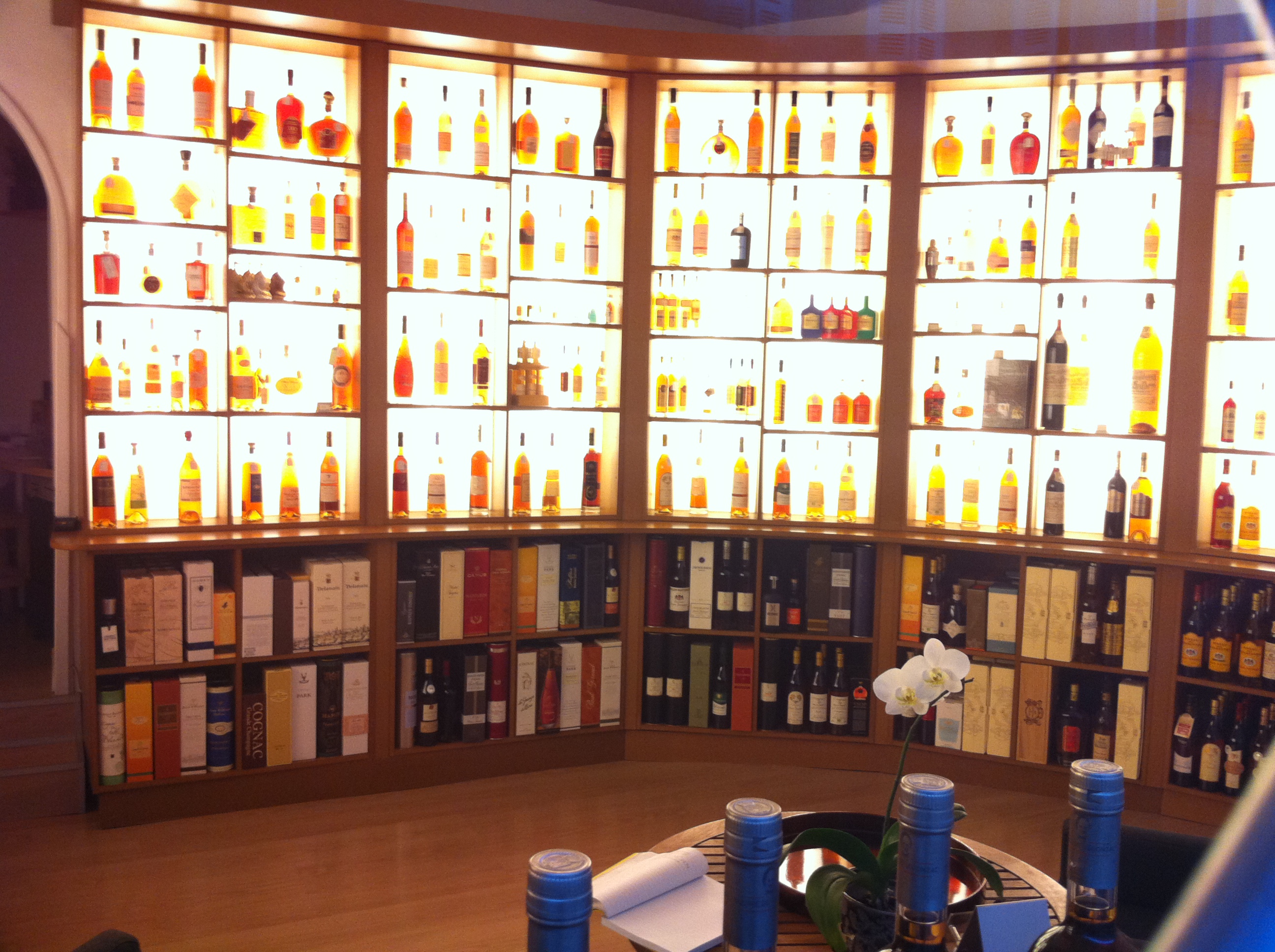
We also discovered another engaging store-front, this time, a display of armagnacs and cognacs – which were actually very popular in the region. Bob is always wondering why more stores and bars don”t make better use of lighting – I wish the picture was better – the whole store was glowing amber.
An Armagnac & cognac shop in Bordeaux. The background appears light here, but in reality it’s a great amber color.
But try as we might, we could not discover that Japanese restaurant. So off to Plan B. To be honest, we knew when we walked in that we should walk out of this little restaurant, but we were so hungry, and at the very least, this place looked like it would be quick. It was the Bordeaux version of the Japanese conveyor-belt sushi restaurant, not so far off from what I had been asking for. The execution of the concept was so poorly done though, machine-made rolls, dried-out rice, fishy-smelling sushi – it was disappointing to settle in for a bad meal, but we were so hungry, we gave up and braved it.
Naturally, we don’t have any good wine recommendations coming out of this dinner experience, but we more than made up for it the next day in Sauternes, and we keep wondering if Seattle needs a champagne shop like Badie…






























 Exact Wines